


Big relief for tourism sector as Ladakh eases rules Five-year registrations, fewer documents, and single-window framework introduced
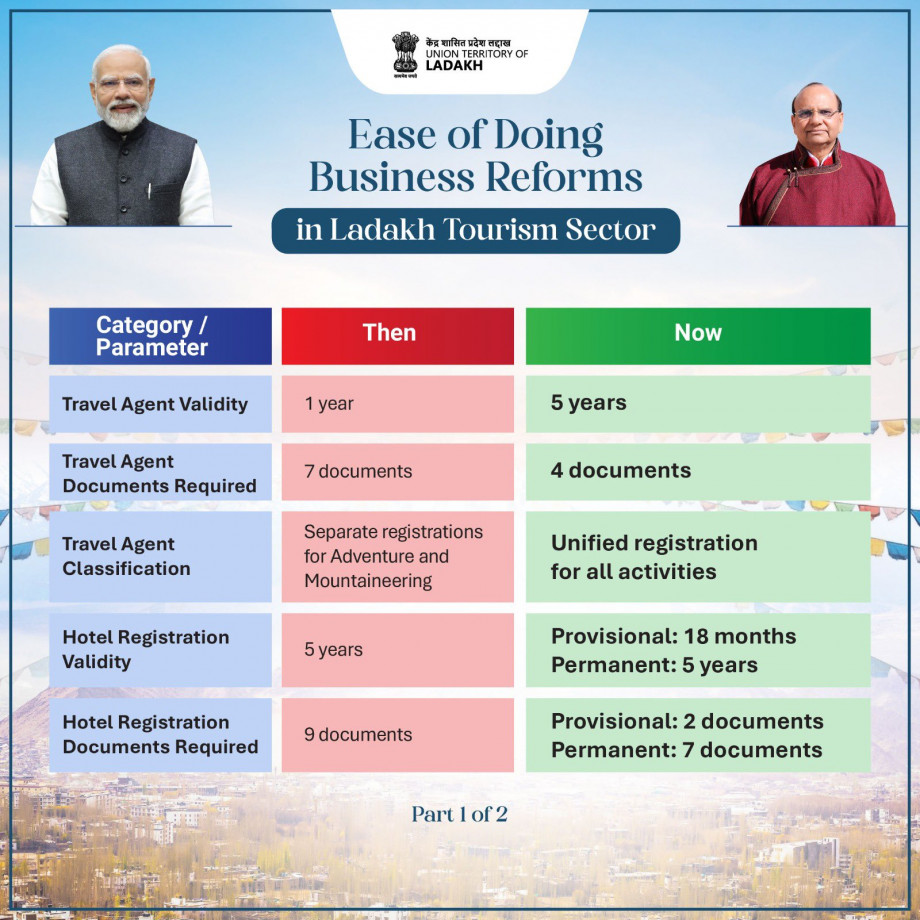
In a major step to promote ease of doing business and boost the tourism sector in Ladakh, Lieutenant Governor Vinai Kumar Saxena on April 24 has approved a set of landmark reforms aimed at deregulating the tourism industry and enhancing the overall visitor experience.
The reforms seek to reduce the compliance burden on stakeholders and establish a unified, streamlined, and citizen-friendly registration framework for tourism units across the Union Territory.
The initiative follows a series of meetings held by the Lieutenant Governor with tourism stakeholders and associations. It aligns with Prime Minister Narendra Modi’s vision of “Minimum Government, Maximum Governance.”
The new framework introduces a unified registration system for all tourism units, significantly reduces documentary requirements, and eliminates redundant classifications. It simplifies procedures for registration, renewal, and transfer, while promoting digital, time-bound approvals. The reforms are also expected to enhance transparency, encourage local entrepreneurship, and strengthen the tourism ecosystem through ease of compliance.
Calling it a “transformative step,” the Lieutenant Governor said the reforms would make processes simpler, more transparent, and people-friendly.
“Reducing compliance burden and ensuring ease of doing business will empower local stakeholders and enhance Ladakh’s standing as a premier tourist destination,” he said, adding that the measures would help position Ladakh among top tourism destinations globally.
As part of the reforms, the validity of registration for tour operators has been extended from one year to five years, eliminating the need for annual renewals.
In another major change, separate registrations for “Adventure Tour Operator” and “Mountaineering Tour Operator,” each requiring an additional fee of ₹3,000, have been scrapped. A unified category titled “Travel Agent” has been introduced, allowing registered entities to undertake all permitted activities under the Registration of Tourist Act.
The number of documents required for tour operator registration has been reduced from seven to four. Requirements such as character certificates, fixed bank balance, and educational qualifications have also been removed, making the process more accessible.
For hotels, the earlier classification into Category I and Category II (Standard, Deluxe, Luxury) has been discontinued. The revised framework requires only two documents for a provisional licence valid for 18 months, and seven documents for a permanent licence valid for five years.
Similarly, the homestay registration process—previously marked by multiple procedural requirements—has been simplified with reduced documentation. This is expected to encourage community-based tourism and create livelihood opportunities for local residents.
The reforms also streamline procedures for transfer of registration, which earlier involved extensive documentation and delays. Simplified mechanisms have been introduced to ensure quicker and more efficient ownership transfers.
Additionally, processes related to cancellation of registration and change of business name have been rationalised, making them faster, more transparent, and less cumbersome for stakeholders.
-
 Reach Ladakh Skara Yokma, Airport Road, Near Councillor Quarter, India.


© 2018 Reachladakh. All rights reserved.
Web designs By : India Internet