


13th Ladakh Marathon witnesses massive global participation Runners from across India and abroad take on challenging high-altitude races
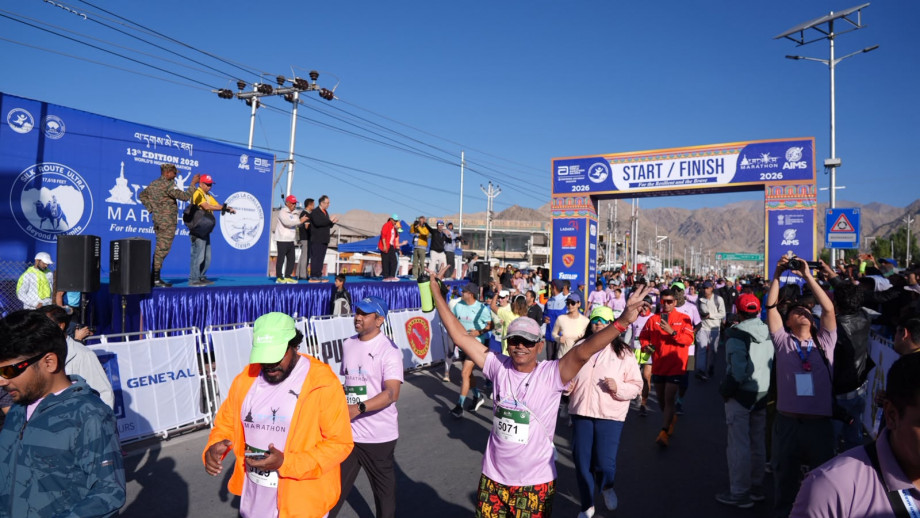
The 13th edition of the Ladakh Marathon witnessed massive participation, with around 7,500 runners from 28 States and six Union Territories taking part in the three-day event held in Leh from September 11 to 13. International participants from all six inhabited continents also took part in the event.
The marathon began with the 122-km Silk Route Ultra and the 72-km Khardung La Challenge, attracting a total of 477 runners in the two ultra-marathon races.
In the 122-km Silk Route Ultra, Nawang Tsering of the Ladakh Police emerged victorious with a timing of 12 hours, 12 minutes and 18 seconds, winning the first prize of ₹5 lakh. Suraj Meena of Rajasthan secured second position and received ₹3.5 lakh, while Rigzen Gyurmeth of 2 Ladakh Scouts finished third and received ₹2.25 lakh.
In the women’s category, Tenzing Dolma secured first position with a timing of 14:26:29, followed by Sufiya Sufi Runner in second with 17:42:08 and Aditi Chaudhary in third with 19:21:18.
In the 72-km Khardung La Challenge, Jigmet Stobdan of the Ladakh Scouts Regimental Centre (LSRC) emerged victorious, winning ₹2.75 lakh. Shabir Hussain, also from LSRC, secured second position and received ₹2 lakh, while Singay Angchok of 2 Ladakh Scouts finished third and received ₹1.75 lakh.
In the women’s category, Disket Dolma led the field with a timing of 7:03:26, followed by Jigmet Dolma in 8:33:16 and Neha Devi in 8:56:15.
This year’s edition carried a record prize pool of ₹1 crore, the highest-ever prize commitment in the history of the Ladakh Marathon, announced by the UT Administration.
On September 12, Chief Secretary, UT of Ladakh, Ashish Kundra, flagged off the 5-km ‘Run for Fun’ from Martyrs’ Chowk, Leh. Around 1,334 participants took part, including students from various schools, government officials, runners from across India and abroad, and specially-abled participants.
The Ladakh Marathon concluded on September 13 with the Full Marathon, Half Marathon and 11.2-km race. Lieutenant Governor Vinai Kumar Saxena flagged off the Full Marathon and Half Marathon, while Ladakh DGP Anand Jain flagged off the 11.2-km race.
In the Full Marathon, Nikhil Singh secured first position, followed by Vipul Kumar in second and Hans Raj in third. In the women’s category, Stanzin Dolkar secured first position, followed by Saraswati Rai and Disket Dolma.
In the Half Marathon, Tsetan Namgyal, Dhola Ram and Sarfaraz Hussain secured first, second and third positions, respectively. In the women’s category, Gargi Sharma, Stanzin Yangdol and Smita Sharma finished first, second and third, respectively.
In the 11.2-km race, Sonam Stanzin, Phurbu Tundup and Mehboob Ali secured first, second and third positions, respectively, in the men’s category. In the women’s category, Stanzin Diskit, Tashi Dolkar and Devanshi Saxena secured first, second and third positions, respectively.
The marathon also contributed significantly to the local tourism economy, generating more than 70,000 bed nights. The 2026 edition contributed approximately ₹40–47 crore directly to the grassroots economy, benefiting local hotels, homestays, family-run guesthouses, taxi operators, restaurants, guides, traditional artisans and small businesses.
Congratulating the winners and participants, Lieutenant Governor Vinai Kumar Saxena appreciated their determination and perseverance in taking on demanding high-altitude races. He said the growing popularity of the two ultra-marathon races demonstrated Ladakh’s potential to emerge as a leading destination for high-altitude sports and adventure tourism.
The Lieutenant Governor said Ladakh’s high altitude, dramatic mountains, vast valleys and unique landscapes provide an exceptional setting for endurance and adventure sports.
He also appreciated the organisers for following a strict zero-single-use-plastic policy and involving local schools and communities in environmental initiatives. He stressed that the growth of sports and adventure tourism must go hand in hand with environmental responsibility.
-
 Reach Ladakh Skara Yokma, Airport Road, Near Councillor Quarter, India.


© 2018 Reachladakh. All rights reserved.
Web designs By : India Internet