


Pre–AI Impact summit held in Leh to explore AI’s role in Ladakh’s development
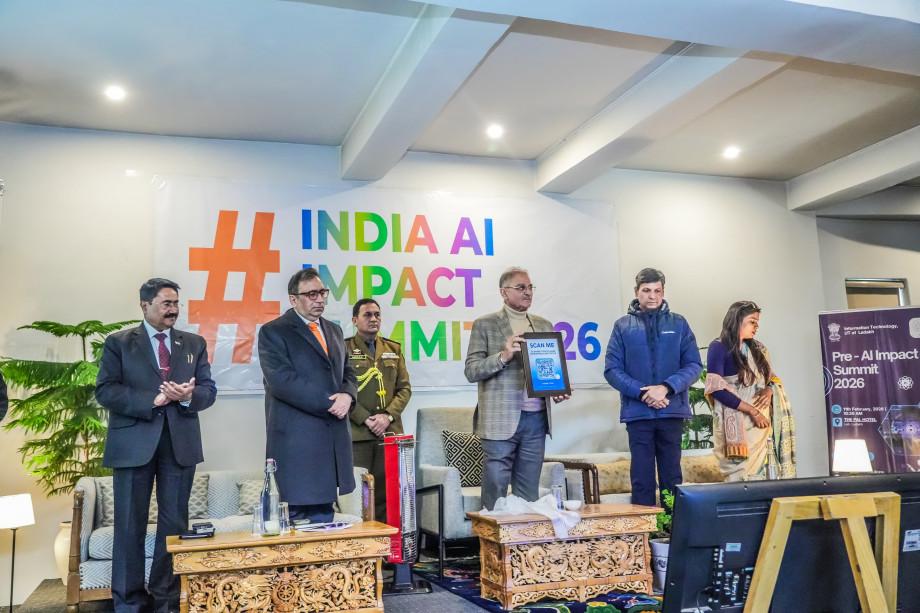
The Information Technology Department, Union Territory of Ladakh, organised a Pre–AI Impact Summit on February 11 aimed at fostering dialogue on the transformative potential of Artificial Intelligence (AI) across governance, education, healthcare, tourism, disaster management, and climate resilience in the region.
Sonam, an IT Consultant, briefed the participants on Artificial Intelligence (AI), highlighting its basic concepts, applications, and growing significance across various sectors.
Pankaj Srivastava said it was an honour to welcome dignitaries, experts, and stakeholders to the AI Impact Summit. He highlighted the collective role of industry, government, academia, and other stakeholders in shaping effective AI governance and education frameworks for Ladakh. He also appreciated the IT Department, UT Ladakh, for spearheading the initiative to position Ladakh at the forefront of responsible AI adoption.
Sachin Singhal, Director Digital Government Advisory, KPMG, shared insights on the paradigm shift in AI-enabled governance, emphasising the need for governments to harness AI responsibly. His presentation covered key themes, including reimagining e-Governance through AI, AI-enabled beneficiary management, transparency, and accountability through data-driven governance.
Dr Mehboob Ali, Department of Computer Science and IT, University of Ladakh, delivered a presentation on Transforming Education through Artificial Intelligence. He highlighted how AI can reduce administrative burden on educators, provide data-driven insights for improved learning outcomes, and enhance accessibility and inclusivity. He also discussed the current usage of AI in higher education, its role in curricula and pedagogy, common AI applications among higher education institutions, and the integration of AI into non-STEM disciplines.
Additionally, he stressed the potential of automated AI-, IoT-, and edge-computing-based poultry farm management systems.
Prof. Mohan, IIT Jammu, shared his views on developing AI innovation infrastructure in the context of Ladakh, focusing on AI-driven solutions for disaster management, smart technologies for extreme climate conditions, and building a culture of innovation and entrepreneurship. And Prof. Reddy spoke on positioning Ladakh as a Global AI–Astronomy Research Sandbox, highlighting the immense potential of large astronomical datasets available in the region.
Saurav Bhaik, CEO, Tagbin, presented on leveraging AI for accessibility and efficient healthcare, underlining the role of intelligent automation in improving operational efficiency and positioning AI as an equaliser in healthcare access.
Ankush Sabarwal, CEO, CoRover, spoke on full-stack sovereign AI solutions, with a special focus on tourism applications. He emphasised tourism as a high-impact use case for sovereign AI and explained the unique capabilities of SLMs and LLMs powering LadakhGPT, showcasing how it is tailored to local needs.
Mohammad Wassim, Founder, Rigo Mind, shared insights on conversational AI agents for tourism, hospitality, and cultural heritage, underlining the vision of building AI for Ladakh, from Ladakh.
Surya from Acres of Ice spoke about the organisation’s commitment to creating innovative and sustainable solutions for communities affected by climate change in Ladakh and the Hindu Kush Himalayan region.
Drawing inspiration from local innovations such as ice terraces and ice stupas—artificial structures designed to store water as ice during winter—they have developed a data-backed and scalable model for constructing artificial ice reservoirs in high-altitude villages.
The post-session proceedings were graced by Lieutenant Governor of Ladakh, Kavindra Gupta; Chief Secretary, UT Ladakh, Ashish Kundra; DGP Ladakh, Mukesh Singh; Administrative Secretary, IT, Shashanka Ala; Other dignitaries present included Administrative Secretaries Bhanu Prabha, Bhupesh Chaudhary, Moses Kunzang, Vice Chancellor, University of Ladakh, Directors, Heads of Departments, speakers, and officials.
During the inaugural session, Secretary, IT, Shashanka Ala, briefed the gathering on the objectives of the summit and presented the Ladakh AI Roadmap. She outlined key outcomes and highlighted three flagship pillars: Government process re-engineering, climate-resilient green digital platforms, and inclusive edge AI solutions.
The Lieutenant Governor, Kavindra Gupta, officially launched the e-Seva Portal and village assessment module during the session and emphasised the importance of establishing an AI Centre of Excellence in Ladakh.
Chief Secretary, Ashish Kundra spoke on the rapid growth of AI and computing capabilities. He cautioned against potential threats and impacts of AI, stressing that AI should be used as a tool for augmentation rather than replacement, while also highlighting concerns related to job displacement.
-
 Reach Ladakh Skara Yokma, Airport Road, Near Councillor Quarter, India.


© 2018 Reachladakh. All rights reserved.
Web designs By : India Internet