


Leh hosts global conference on strengthening election management bodies
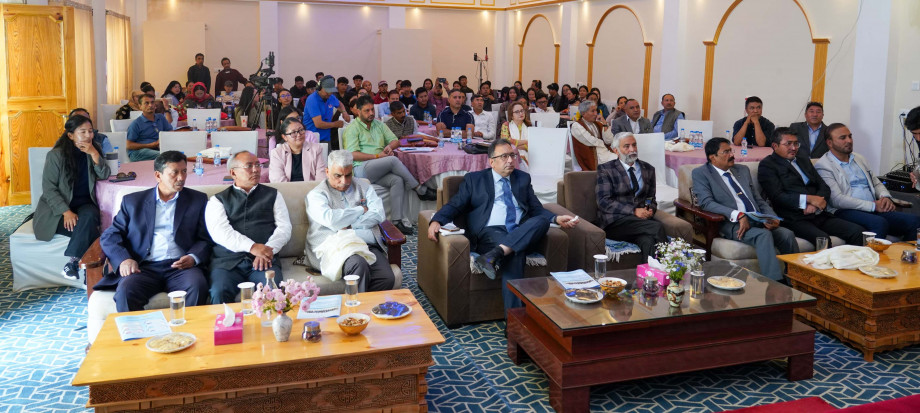
Chief Secretary of the Union Territory of Ladakh, Ashish Kundra, inaugurated a two-day International Conference on "Legal Framework of Election Management Body Independence" at Hotel Diskitsal, Leh, on July 23. The conference brought together constitutional experts, election administrators, legal scholars, academicians and international delegates to deliberate on strengthening the institutional independence of Election Management Bodies (EMBs) and advancing democratic governance.
The conference is being organised by the Office of the Chief Electoral Officer, UT Ladakh, in collaboration with the India International Institute of Democracy and Election Management (IIIDEM), the Election Commission of India (ECI) and the International Institute for Democracy and Electoral Assistance (International IDEA).
The inaugural session was attended by senior officials of the Election Commission of India, the Chief Electoral Officer and Deputy Chief Electoral Officer of Ladakh, Vice Chancellors of the University of Ladakh and the Central University of Ladakh, constitutional and legal scholars, representatives of International IDEA, foreign delegates, members of the judiciary and tribunals, heads of various government departments, students and early-career researchers from across the country.
Welcoming the participants, Chief Electoral Officer, UT Ladakh, Rahul Sharma, described the conference as an important platform for dialogue on strengthening democratic institutions through independent, transparent and accountable election management systems. He said credible electoral institutions are the cornerstone of democracy and stressed the need for continuously evolving legal frameworks to address emerging challenges while safeguarding the voting rights of every eligible citizen, irrespective of geographical location. He also acknowledged the support of the Election Commission of India, IIIDEM, International IDEA and the resource persons for facilitating meaningful academic deliberations on electoral governance.
Delivering the keynote address, Chief Secretary Ashish Kundra underscored the vital role of independent Election Management Bodies in preserving the integrity and credibility of democratic systems. He noted that India's electoral process has continuously evolved under the constitutional framework to ensure inclusivity, transparency and universal participation. Tracing the country's electoral journey from ballot boxes to Electronic Voting Machines (EVMs), he highlighted the Election Commission of India's commitment to technological innovation while upholding the principles of free and fair elections.
Kundra said technological advancements such as EVMs, Voter Verifiable Paper Audit Trail (VVPAT) systems and ongoing research on remote voting solutions demonstrate India's leadership in electoral innovation. Referring to pilot initiatives, including blockchain-based remote voting technologies, he said these innovations have the potential to enhance participation among migrant voters while maintaining the integrity and transparency of the electoral process. He emphasised that public trust remains the foundation of every democratic election and that every reform must strengthen the credibility of electoral institutions.
Highlighting the conference theme, the Chief Secretary said discussions on the constitutional and statutory foundations of Election Management Bodies are essential for reinforcing institutional autonomy, accountability and resilience. He expressed confidence that the deliberations would contribute to strengthening electoral governance and help develop best practices for democratic institutions in India and abroad.
A major highlight of the inaugural session was the presentation of an international research initiative examining the legal and institutional independence of Election Management Bodies across more than 150 jurisdictions. The study proposes a three-tier framework comprising 64 Model International Electoral Standards (MIES), designed as aspirational benchmarks for assessing institutional independence, legal safeguards, accountability and operational effectiveness. The conference aims to validate these standards through comparative research, expert consultations and practical experiences shared by election management practitioners from around the world.
Following the inaugural session, the conference commenced its first technical session on "Constitutional and Statutory Foundations of Election Management Body Independence." Moderated by Dr. Alok Puri, Assistant Professor, University of Jammu, the panel featured Prof. Mukesh Sharma, Dr. Khalid Waseem Hassan, Dr. Jain Sabel, Dr. Sandeep Singh, Dr. Nitin, Dr. Shazia Malik and Dr. Konchok Chorol. The panellists discussed constitutional safeguards, statutory frameworks, comparative international practices and the alignment of national legal systems with emerging global electoral standards.
During the session, Sonam Chosjor presented an overview of the Model International Electoral Standards (MIES) framework, explaining its three-tier assessment mechanism for evaluating constitutional guarantees, legal provisions and the practical implementation of institutional independence. The discussion also examined comparative experiences from different jurisdictions, identifying best practices and institutional gaps that could inform future electoral reforms.
The second technical session focused on "Appointment, Tenure, Removal and Financial Autonomy of Election Management Bodies." Moderated by Dr. Khalid Waseem Hassan, the session examined institutional safeguards required to ensure the independence of electoral bodies, including appointment procedures, tenure security, financial autonomy and accountability mechanisms. Experts from IIIDEM, legal institutions and academia deliberated on international standards, judicial safeguards and comparative constitutional practices.
The interactive sessions concluded with active participation from students and young researchers, who raised questions on electoral reforms, representation, institutional independence and constitutional accountability, reflecting the growing engagement of youth in democratic governance.
The two-day conference will continue with technical sessions, research presentations and expert discussions aimed at developing practical recommendations to strengthen the legal and institutional framework governing Election Management Bodies and promote resilient, transparent and independent democratic institutions.
-
 Reach Ladakh Skara Yokma, Airport Road, Near Councillor Quarter, India.


© 2018 Reachladakh. All rights reserved.
Web designs By : India Internet