


Ladakh’s saffron experiment blossoms in record 30 days
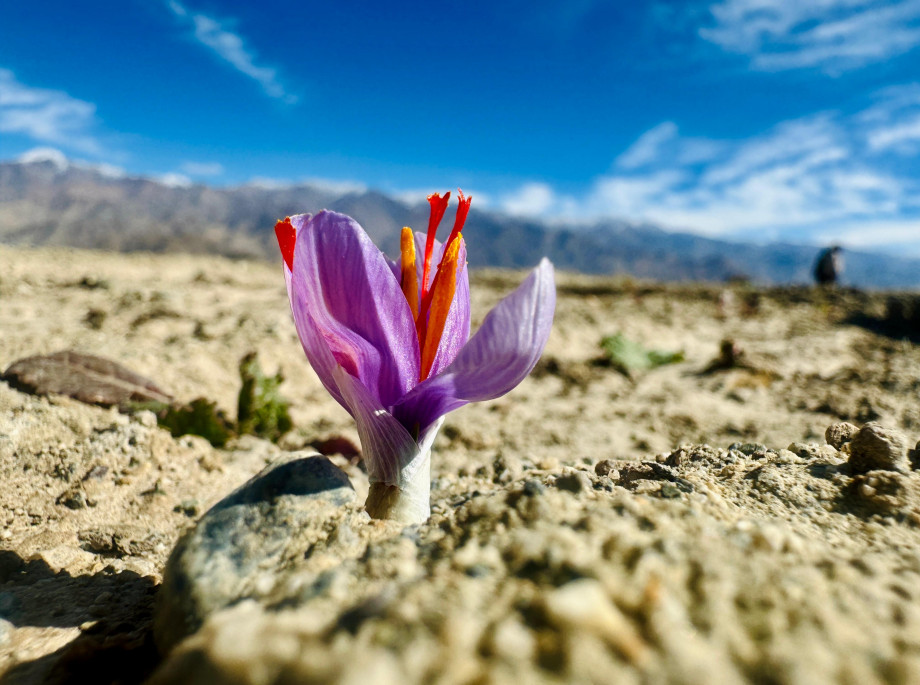
Breaking new ground in Ladakh’s high-altitude agricultural landscape, the experimental saffron cultivation project initiated by Lieutenant Governor VK Saxena on recently restored degraded land in Leh has begun to blossom, with the first bloom recorded in just 30 days, against the typical two-month timeline.
The Lieutenant Governor, on November 1, inspected the saffron field to witness the first bloom. He was informed that the cultivation site is currently averaging 20 to 25 blooming flowers daily, with a peak of 72 flowers recorded in a single morning. The promising growth has resulted in the successful collection of nearly 22 grams of pure saffron in just four days.
As part of the ambitious experiment, nearly 800 kg of premium Iranian saffron corms, numbering approximately 90,000, were planted across nearly 4,000 square metres of land that was previously barren and has recently been restored and rejuvenated under Project Him Sarovar, guided by LG Saxena. The plantation was undertaken on October 1, with the first bloom reported in less than 30 days.
The initiative aligns with Prime Minister Narendra Modi’s vision of diversifying traditional agricultural practices to promote financial sustainability and economic empowerment of farmers and youth.
Saffron cultivation in Ladakh builds on the Administration’s successful experiments with high-value floriculture, particularly the large-scale cultivation of Lilium and Gladiolus in Leh, which has opened new employment and livelihood opportunities for farmers, Self-Help Groups and local entrepreneurs.
“This remarkable achievement is a powerful testament to the resilience of the local environment and highlights the immense, untapped potential of high-altitude farming in the Ladakh region. The breakthrough of this pilot project also lays a promising foundation for future commercial-scale saffron production. It will open highly lucrative new avenues for crop cultivation and agro-based entrepreneurship in Ladakh, actively paving the way for a stronger, thriving, and self-reliant local economy,” LG Saxena said.
Saffron is a high-value crop with strong market demand and commands a premium price, offering farmers the potential to earn additional and remunerative income. Jammu and Kashmir is the primary saffron-producing region in India, accounting for approximately 90 per cent of the country’s total production.
Its introduction in Ladakh is being undertaken as a pilot project to assess its suitability to the region’s climatic conditions and explore its economic potential.
The Lieutenant Governor also appreciated the officials of the Agriculture Department, UT Ladakh, and the dedicated field staff for their significant contributions, expertise and commitment in ensuring the success of this pioneering initiative.
-
 Reach Ladakh Skara Yokma, Airport Road, Near Councillor Quarter, India.


© 2018 Reachladakh. All rights reserved.
Web designs By : India Internet