


L-G VK Saxena flags off India’s first high-altitude snow leopard wildlife safari in Ladakh Initiative aims to promote responsible tourism, protect fragile habitats and create livelihood opportunities for local communities
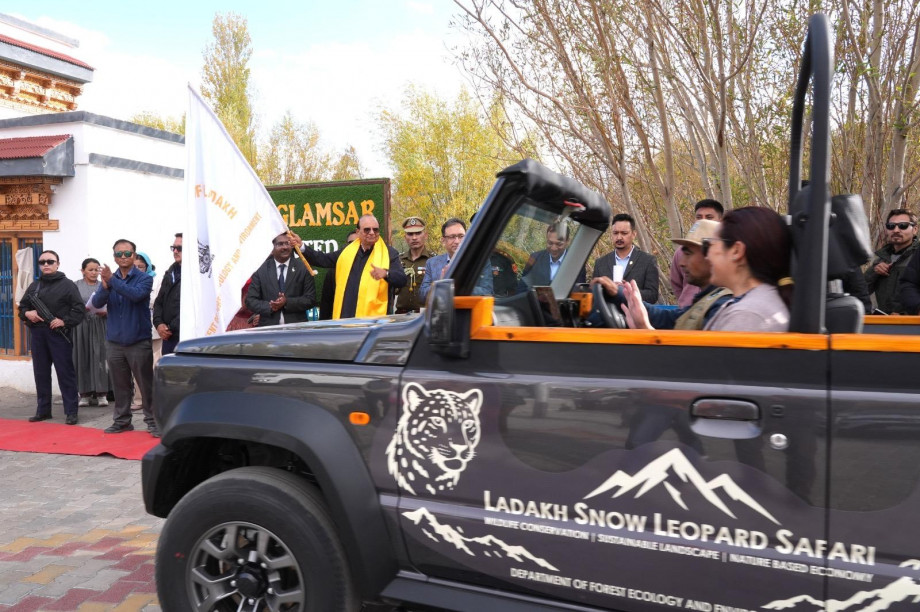
India’s first high-altitude wildlife safari in Ladakh became a reality on October 7, with Lieutenant Governor Vinai Kumar Saxena flagging off six vehicles for the Ladakh Snow Leopard Safari.
The initiative marks a major step towards promoting responsible wildlife tourism and community-based conservation in the Union Territory, while creating sustainable livelihood opportunities for local youth and communities. The decision to introduce wildlife safaris in Ladakh was announced on August 5 this year and has been implemented within two months.
The initiative has been launched by the Snow Leopard and High-Altitude Nature Conservation (SHAN) Society in collaboration with the Department of Forest, Ecology and Environment, UT Ladakh.
The vehicles will initially operate in identified areas including Rumbak, Shang and Uley, where snow leopards are frequently sighted, offering visitors a rare opportunity to observe Ladakh’s distinctive wildlife and natural environment under guided and regulated conditions.
Specially designed open-back vehicles, trained local drivers and wildlife guides will be deployed for the safari. Suitable routes are being identified across Hemis National Park, Changthang and Karakoram Wildlife Sanctuary, as well as Nubra, Zanskar, Sham, Kargil and Drass.
The guided safari aims to prevent illegal off-roading and disturbance to wildlife while promoting sustainable, responsible and eco-friendly tourism. It also seeks to establish a conservation model in which local communities become active partners in protecting Ladakh’s fragile ecosystem and wildlife.
The initiative is expected to strengthen a sense of custodianship among local communities while creating sustainable livelihood opportunities linked to conservation.
Emphasising that the initiative is not merely about increasing tourism, L-G Saxena said the safari has been designed to make wildlife tourism responsible, regulated and compatible with conservation. Regulated visitor numbers, approved routes and trained local personnel will help minimise disturbance to wildlife while generating direct livelihood opportunities for local communities.
“Wildlife should not be protected at the cost of people, nor should development come at the cost of wildlife. We must create a model in which both can thrive together,” said L-G Saxena.
He added that a local guide earning from a snow leopard sighting, a woman earning through conservation-linked handicrafts and a village benefiting from protecting its wetland are examples of how conservation can become an economic opportunity.
Ladakh has the country’s largest snow leopard population, with an estimated 477 snow leopards out of a national population of around 718. The region is also home to more than 38 mammal species, over 340 bird species and around 1,800 vascular plant species.
The Lieutenant Governor said protecting this natural heritage is an investment in Ladakh’s ecological security, local livelihoods and future economy. He stressed that tourism promotion and environmental protection must go hand in hand, adding that while the Administration welcomes visitors, it would act firmly against activities that damage Ladakh’s fragile ecology.
The snow leopard safari vehicles were flagged off during the Wildlife Week 2026 celebrations at Choglamsar Protected Forest, Leh, being observed under the theme “Connecting Habitats, Thriving Wildlife.”
The Wildlife Week programme also highlighted the Administration’s efforts to build a conservation economy by linking wildlife protection with local livelihoods. Twenty local youth are being trained in bird identification, birdwatching and wildlife spotting and will be provided with binoculars. Bird-watching hides will also be developed at major hotspots.
The initiative aims to create opportunities for young people as wildlife guides, bird guides, nature interpreters and eco-tourism entrepreneurs.
The Wild Animal Felting Programme, involving 50 women from Turtuk, Photoksar, Sangrah, Chushul and Shargole, was also highlighted as an example of linking traditional skills and local wool with conservation-based enterprises.
The Lieutenant Governor called for greater focus on design, branding, market access and e-commerce to strengthen such women-led enterprises.
Calling for a shift towards high-value, low-impact and knowledge-based tourism, Saxena emphasised that carrying capacity, visitor numbers, wildlife disturbance, waste management and plastic pollution must be strictly regulated.
“When habitats remain connected, wildlife thrives. When wildlife thrives, communities benefit. And when communities benefit from conservation, conservation itself becomes sustainable,” said L-G Saxena.
During the event, cheques were handed over to the Chief Education Officers of Leh and Kargil for distribution to 50 schools for conservation education through Eco Clubs supported by SHAN Society.
Certificates were also presented to winners of poster painting, quiz, wildlife and nature conservation reel-making, and logo-designing competitions.
The Lieutenant Governor also inaugurated an AI-based Human-Wildlife Conflict Mitigation Device developed by the Wildlife Division, Kargil, in technical collaboration with the University of Ladakh, Kargil Campus.
He also released a documentary on the Himalayan Brown Bear and a brochure on wildlife tourism packages offered by SHAN Society. The second edition of the Ladakh Black-necked Crane Festival was also announced on the occasion.
-
 Reach Ladakh Skara Yokma, Airport Road, Near Councillor Quarter, India.


© 2018 Reachladakh. All rights reserved.
Web designs By : India Internet