


L-G Vinai Kumar Saxena visits University of Ladakh Campus at Taru Emphasises academic excellence, research and student welfare; envisions green university
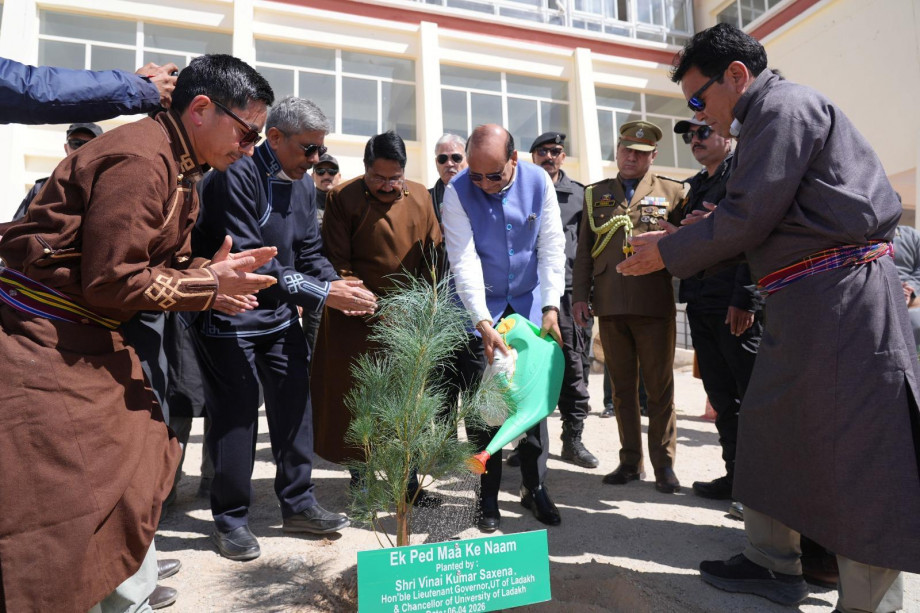
Lieutenant Governor of Union Territory of Ladakh, Vinai Kumar Saxena, visited the University of Ladakh campus at Taru on April 6 to review academic, research and infrastructure facilities, and to interact with faculty and students.
The Lieutenant Governor was accorded a warm welcome by Vice-Chancellor Prof. Saket Kushwaha, Administrative Secretary, Higher Education, Bhanu Prabha, and faculty members.
During his visit, Saxena planted a sapling under the “Ek Ped Maa Ke Naam” initiative, reiterating his commitment to environmental conservation. He visited the Central Library and the Artificial Intelligence Data Centre, and inspected exhibition stalls showcasing locally developed agricultural and technological products, including medicinal plants and millet-based items.
At the AWaDH Centre, the Lieutenant Governor witnessed a demonstration of Ladakh-specific Modelling and Space Applications (LAMA), along with a presentation by students of the Forensic Science Laboratory, who demonstrated sample collection, mapping, and on-the-spot testing techniques. He commended the professionalism and technical competence displayed by the students.
Saxena also visited the Science Block, where he interacted with students and assured them that the UT Administration would take necessary measures for their welfare, including facilitating exposure visits to reputed institutions across the country.
Addressing faculty and staff, the Lieutenant Governor expressed satisfaction with the infrastructure and academic environment at the University, describing the laboratories and facilities as exemplary. He noted that the University holds immense potential for growth and encouraged further strengthening of specialised areas such as forensic sciences.
Highlighting recent reforms in the criminal justice system through the Bharatiya Nyaya Sanhita (BNS), Bharatiya Nagarik Suraksha Sanhita (BNSS), and Bharatiya Sakshya Adhiniyam (BSA), he emphasised the growing importance of scientific evidence in investigations and the need to enhance capacity in forensic science laboratories.
Praising the LAMA initiative, Saxena observed that such data-driven modelling systems would assist the UT Administration in evidence-based planning and decision-making. He also highlighted the advanced laboratory facilities at the University, noting their potential in identifying mineral resources in Ladakh, which he described as a region rich in untapped mineral wealth.
The Lieutenant Governor emphasised Ladakh’s vast opportunities in sectors such as tourism, the food industry, handicrafts, handloom and floriculture. He remarked that only a fraction of the region’s tourism potential has been explored and called for concerted efforts to develop Ladakh into a global tourism hub, with active support from the University.
He underscored the need to curb student migration from Ladakh to other states by strengthening local institutions. Noting that studying outside the region can place financial strain on families and expose students to challenges, he stressed the importance of enhancing academic standards and expanding course offerings to attract both local and outstation students.
Saxena added that increased student footfall from outside Ladakh would help dispel misconceptions about the region’s climate and terrain, while also boosting tourism. With the onset of the tourist season, he informed that the number of daily flights to Ladakh is being increased from eight to eighteen in April, with additional flights under consideration to further boost tourist inflow.
Outlining his vision, the Lieutenant Governor emphasised the development of the University of Ladakh as a “Green University.” He called for sustained plantation drives and sought the institution’s active cooperation in achieving the target of increasing Ladakh’s green cover to five percent within the next two years.
He concluded by assuring full support from the UT Administration in strengthening the University and transforming it into one of the country’s premier institutions, equipped with world-class infrastructure and modern teaching facilities.
-
 Reach Ladakh Skara Yokma, Airport Road, Near Councillor Quarter, India.


© 2018 Reachladakh. All rights reserved.
Web designs By : India Internet