


L-G launches mega project to revive Tso Kar lake 320 million litres of glacier water a day to be channelised into shrinking lake
After successfully channelising 90 million litres of Stok Glacier water into canals serving Igoo-Phey and Chuchot villages to irrigate parched agricultural land near Leh, Lieutenant Governor of Ladakh, Vinai Kumar Saxena, has taken up an ambitious project to revive and rejuvenate the shrinking Tso Kar Lake in Changthang.
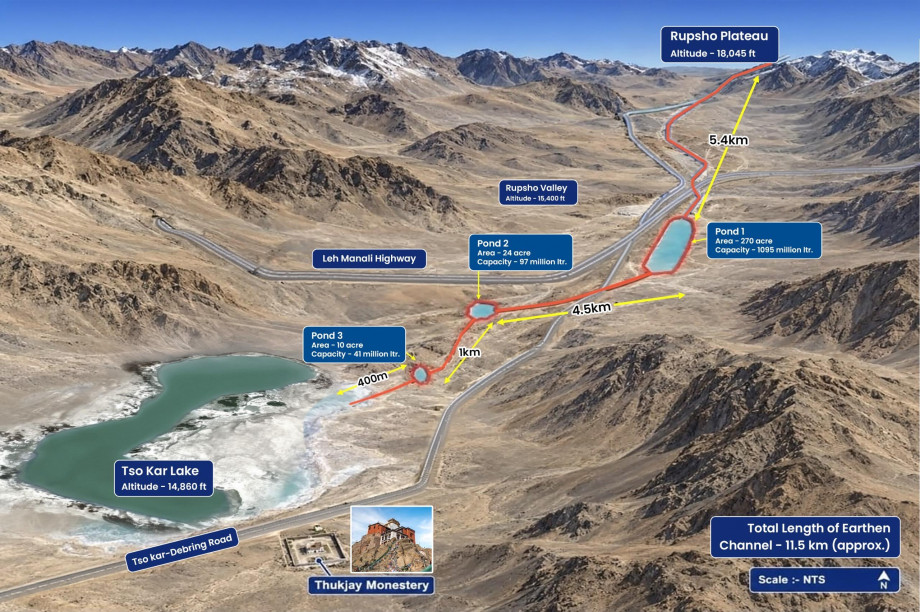
The project involves channelising untapped glacier meltwater from the Rupsho Kharnak stream, located at an altitude of nearly 18,000 feet and around 11 km from Tso Kar, into the lake, which lies at an altitude of nearly 15,000 feet.
The project envisages diverting an average of 132 cusecs, equivalent to around 320 million litres of water per day, from the Rupsho Kharnak stream to Tso Kar. At present, the glacier water flows downstream into the Sindhu River.
Tso Kar, one of Ladakh’s most iconic high-altitude lakes, has reportedly shrunk by nearly 70% over the last decade. Once spread across nearly 11,000 acres, the lake has now reduced to around 3,200 acres. Its decline has also affected the habitat of migratory birds, including the famed Black-necked Crane, with a significant reduction in the number of birds arriving at the site.
The Administration expects that the project, by fully utilising the available glacier water, could help restore Tso Kar substantially within a year.
The initiative is being described as a major high-altitude lake restoration effort, undertaken in the challenging climatic conditions of Ladakh, where summer temperatures remain low and winter temperatures can fall to minus 20 to 30 degrees Celsius.
The project was conceived by L-G Saxena during his visit to Tso Kar on August 10, 2026. During the visit, local villagers informed him about the rapid shrinking of the lake and the sharp decline in its avian population.
Following the visit, the L-G directed the Public Health Engineering (PHE) Department to conduct a detailed survey of the area. After 15 days of fieldwork, the department submitted its report on August 30, proposing the construction of an 11-km RCC channel.
However, considering the ecological concerns and the harsh winter conditions, L-G Saxena suggested avoiding the construction of a new RCC channel. Instead, he directed that the water be brought to the first natural depression through a simple earthen channel. Work began on a war footing from September 2, ahead of the onset of winter.
The project utilises three natural depressions along the downward flow of the glacier stream towards Tso Kar. The first depression covers 270 acres, the second 24 acres and the third 10 acres.
Water from the Rupsho Kharnak stream is first being channelised into the largest depression. It will then flow into the second and third depressions before being diverted into Tso Kar, located around 400 metres from the third depression.
Check dams fitted with three RCC pipes will be constructed at the outlets of the three depressions to regulate the flow and augment water levels. From the third depression, the water will reach Tso Kar through gravity flow using simple, low-cost earthworks, without the construction of concrete channels.
Since September 9, around 20 cusecs of water from the Rupsho Kharnak stream has been successfully diverted to the first depression, which has already begun filling rapidly. The water is being channelised through an earthen channel as well as a concrete canal that had remained defunct at the site since 1995.
Within four days, around 20% of the first depression had already been filled.
The cascading system is expected to provide additional ecological benefits. Before reaching Tso Kar, the three natural depressions will create new freshwater wetlands and allow sediments to settle, enabling relatively clear water to enter the main lake.
The three new water bodies, covering 270, 24 and 10 acres respectively, are expected to hold nearly 1,230 million litres of water. They could also provide new habitats for migratory birds and serve as potential tourist attractions, as they are visible from the adjoining Leh-Manali Highway.
“The success of the Stok Glacier project has proven that large-scale, sustainable water management is entirely feasible in our cold desert using simple engineering. By redirecting the Rupsho Kharnak stream, we aim to bring life back into Tso Kar Lake. The project stands as a vital blueprint for high-altitude ecological restoration. By transforming untapped glacier water into permanent lifelines, Ladakh is taking decisive steps towards agricultural prosperity, revitalised rural economies and long-term climate resilience. This will ensure that iconic landscapes like Tso Kar and the life they sustain are preserved for generations to come,” said L-G Saxena.
During his August 10 visit, the L-G was also informed by local villagers and the Nambardar that Tso Kar was once a large and thriving body of glacial water that supported centuries of local salt trading and maintained a delicate ecological balance. Its continued recession has resulted in the loss of grazing grounds and a decline in bird populations, with extensive dry patches now visible around the lake.
The revival of Tso Kar is also expected to have a direct impact on local livelihoods. Many communities around the lake are engaged in Pashmina goat herding. As the lake has receded, grazing grounds have diminished, forcing herders to travel 50 to 75 km away from their homes in search of pasture.
The restoration of the lake is expected to create grasslands, improve grazing opportunities and generate livelihood opportunities for local communities, potentially enabling Pashmina herders to return closer to their homes.
-
 Reach Ladakh Skara Yokma, Airport Road, Near Councillor Quarter, India.


© 2018 Reachladakh. All rights reserved.
Web designs By : India Internet