


From barren land to saffron fields: New agricultural experiment in Ladakh
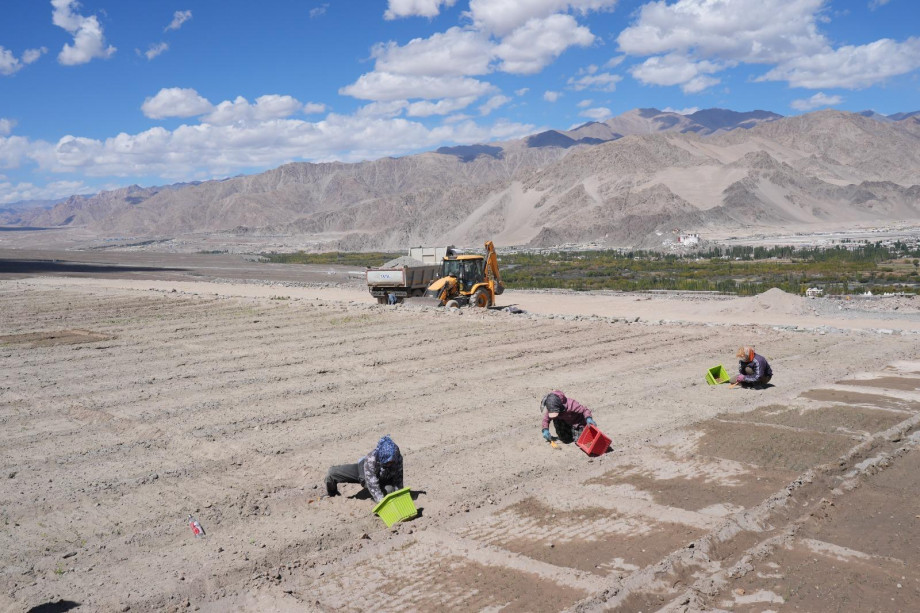
A tract of land in Leh that remained barren until three months ago is set to produce saffron for the first time in Ladakh.
Following the success of Lilium cultivation in Ladakh, Lieutenant Governor Vinai Kumar Saxena has undertaken another agricultural diversification initiative by introducing saffron cultivation in the cold desert region.
As part of the pilot project, nearly 800 kg of saffron corms, numbering around 90,000, have been planted across approximately 4,000 square metres of land that was previously barren and has recently been restored and rejuvenated under Project Him Sarovar, guided by the L-G.
Agriculture experts said the saffron corms are expected to produce a good quantity of saffron.
The initiative is aligned with Prime Minister Narendra Modi’s vision of diversifying traditional agricultural practices to promote financial sustainability and economic empowerment among farmers and youth. The saffron plantation builds on the Administration’s experiments with high-value floriculture, particularly the cultivation of Lilium and Gladiolus in Leh, which have created employment and livelihood opportunities for farmers, Self-Help Groups and local entrepreneurs.
The pilot cultivation is being undertaken at Command Area Gate No. 27 at Spituk Pharka, Leh. High-quality Iranian saffron corms with a circumference of 8 to 10 cm, a diameter of 2.5 to 3 cm or more, and weighing at least 10 grams have been planted. These specifications are considered suitable for high-quality saffron production.
L-G Saxena said the initiative has the potential to strengthen the local economy by introducing another high-value crop suited to Ladakh’s unique high-altitude agro-climatic conditions. He said the experiment would also challenge the perception that saffron cannot be grown in Ladakh and that barren or degraded land cannot be restored for productive use.
“Our endeavour is to transform degraded and barren land into productive assets and create new opportunities for our farmers. The introduction of saffron is another important experiment in crop diversification, which can open a new avenue for enhancing farmers’ incomes through a premium-value crop,” said L-G Saxena.
Saffron is a high-value crop with strong market demand and commands a premium price, offering farmers the potential for an additional source of income. Jammu and Kashmir is the primary saffron-producing region in India, accounting for approximately 90 per cent of the country’s total production. Its introduction in Ladakh is therefore being undertaken as a pilot project to assess its suitability to the region’s climatic conditions and explore its economic potential.
The saffron plantation site forms part of around 800 acres of land being restored in Leh through the supply of fresh water from the adjoining Igoo-Phey irrigation canal, which was recently restored and made operational.
On the directions of the Lieutenant Governor, unutilised or excess water from the canal is being channelled towards the barren land to improve its moisture content and make it suitable for cultivation.
The Command Area also has four water ponds developed under Project Him Sarovar adjacent to the plantation site, with a combined storage capacity of around 24 million litres.
-
 Reach Ladakh Skara Yokma, Airport Road, Near Councillor Quarter, India.


© 2018 Reachladakh. All rights reserved.
Web designs By : India Internet