


Chief Secretary reviews heritage conservation and medicinal flora in Nubra
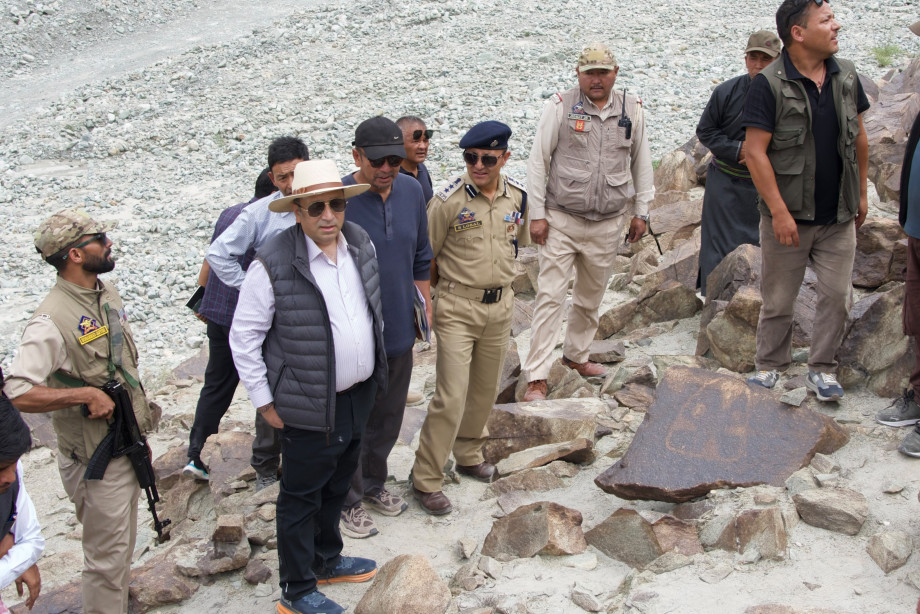
Chief Secretary of the Union Territory of Ladakh, Ashish Kundra on August1, visited the ancient petroglyph site near Murgi village and reviewed the region's rich medicinal plant resources, reaffirming the Administration's commitment to preserving Ladakh's unique cultural heritage while promoting the sustainable utilisation of its natural wealth.
Continuing his visit from the Village Lab Foundation at Sumoor, the Chief Secretary proceeded to the petroglyph site at Murgi village, where he was briefed by noted archaeologist Prof. Tashi Ladawa on the historical significance of the ancient rock engravings. Believed to be thousands of years old, the petroglyphs depict ibex, human figures, masks, hunting scenes and other motifs that offer valuable insights into the cultural and social life of the region's early inhabitants. He was informed that the site is among the largest concentrations of petroglyphs in Ladakh and represents a significant archaeological heritage.
During the visit, Kundra interacted with local residents and enquired about tourist footfall and the measures being undertaken for the conservation and promotion of the site.
Emphasising the need to preserve the invaluable heritage, he suggested developing visitor-friendly infrastructure, including improved pedestrian access, informative signage explaining the historical significance of the engravings, and appropriate lighting to enhance visitor experience while ensuring the protection of the rock art.
Members of the local community also submitted a memorandum seeking improved road connectivity, construction of a bridge, better healthcare facilities and other basic civic amenities. The Chief Secretary assured them that the concerned departments would examine their concerns.
Later, Kundra reviewed the medicinal plant resources of the region in the presence of Divisional Forest Officer, Leh, Vishal, and Dr. Punchok Angmo, Consultant, State Medicinal Plant Board, UT Ladakh. During the field visit, he was introduced to several naturally occurring high-altitude medicinal plant species found in the Warila mountain region and was briefed on their medicinal properties, ecological importance and traditional applications in the Sowa-Rigpa system of medicine.
The Chief Secretary subsequently visited a medicinal plant cultivation field, where he inspected ongoing cultivation practices, irrigation facilities, seed production and post-harvest management. He also interacted with farmers and officials on cultivation techniques, marketing channels, commercial viability and opportunities for expanding medicinal plant cultivation.
Highlighting the immense potential of Ladakh's medicinal flora, Kundra stressed the need for scientific research, conservation, value addition and stronger market linkages to promote the sector on an industrial scale while ensuring sustainable harvesting practices. He observed that medicinal plants hold immense value not only for healthcare and traditional medicine but also for livelihood generation and environmental conservation.
The Chief Secretary also explored the feasibility of introducing additional medicinal plant varieties suited to Ladakh's agro-climatic conditions and underscored the importance of integrating traditional knowledge with scientific innovation to unlock the full potential of the region's medicinal plant resources.
Photo Caption: Chief Secretary of the Union Territory of Ladakh, Ashish Kundra during his visit to the ancient petroglyph site near Murgi village.
-
 Reach Ladakh Skara Yokma, Airport Road, Near Councillor Quarter, India.


© 2018 Reachladakh. All rights reserved.
Web designs By : India Internet