


9th Rashtriya Poshan Maah launched with focus on strengthening Anganwadi services
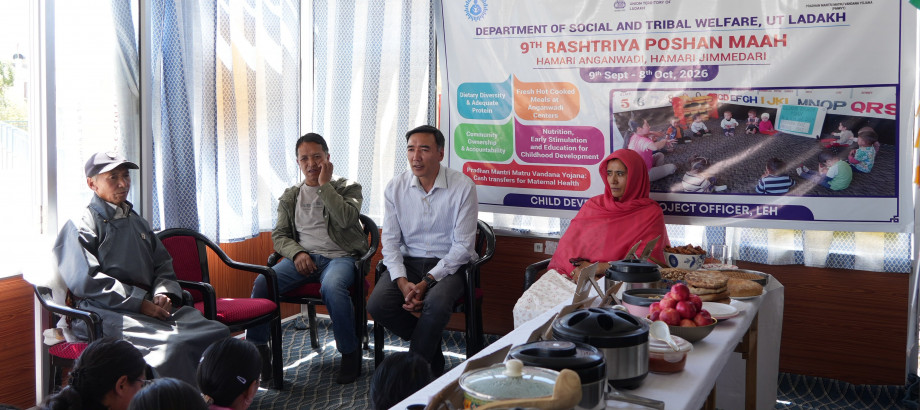
The Department of Social and Tribal Welfare on September 9 launched the 9th Rashtriya Poshan Maah under the theme “Hamari Anganwadi, Hamari Jimmedari” at the ICDS Centre, Council Model School, Ibex Colony, Leh.
The month-long campaign, being observed from September 9 to October 8, 2026, focuses on nutrition, maternal and child health, early childhood care and development, and strengthening community participation in Anganwadi services.
The programme was attended by Director, Social and Tribal Welfare, Zhida Bano; District Programme Officer, Rigzin Spalgon; Child Development Project Officer (CDPO), Leh, Zarina Bano; Principal, Council Model School; members of the Village Education Committee (VEC); and supervisors and Anganwadi Workers.
Addressing the gathering, CDPO Leh Zarina Bano highlighted the significance of Rashtriya Poshan Maah and emphasised the importance of early childhood care and education in line with the objectives of the National Education Policy. She said quality pre-school education, proper nutrition, health education and holistic early childhood development are essential for laying a strong foundation for children’s future growth and learning.
She also stressed the importance of dietary diversity and adequate protein intake among children, particularly during the early years, to support their physical and cognitive development. She called upon Anganwadi Workers and parents to promote healthy dietary practices and ensure that children receive nutritious and balanced meals.
District Programme Officer Leh Rigzin Spalgon highlighted the importance of Rashtriya Poshan Maah as an initiative to strengthen awareness about nutrition, maternal and child health, and early childhood development. He emphasised greater community participation in promoting nutritional awareness and ensuring the holistic development of children.
He further stressed the importance of convergence between Anganwadi Centres and schools, stating that such an approach can facilitate a smooth transition of children from pre-school education to primary schooling while ensuring continued attention to their nutritional, health and developmental needs.
Spalgon also highlighted the evolution and significance of the Integrated Child Development Services (ICDS) programme, launched in the 1970s to provide comprehensive services related to nutrition, health and early childhood development to children and mothers. He underscored the continued importance of Anganwadi Centres in delivering these services at the grassroots level.
The programme also focused on creating greater awareness among parents, Anganwadi Workers and the community about nutrition, child health, early childhood education and the importance of community participation in strengthening Anganwadi services.
-
 Reach Ladakh Skara Yokma, Airport Road, Near Councillor Quarter, India.


© 2018 Reachladakh. All rights reserved.
Web designs By : India Internet