


In Conversation with State Awardee Konchok Rigzin, Thanka Artist
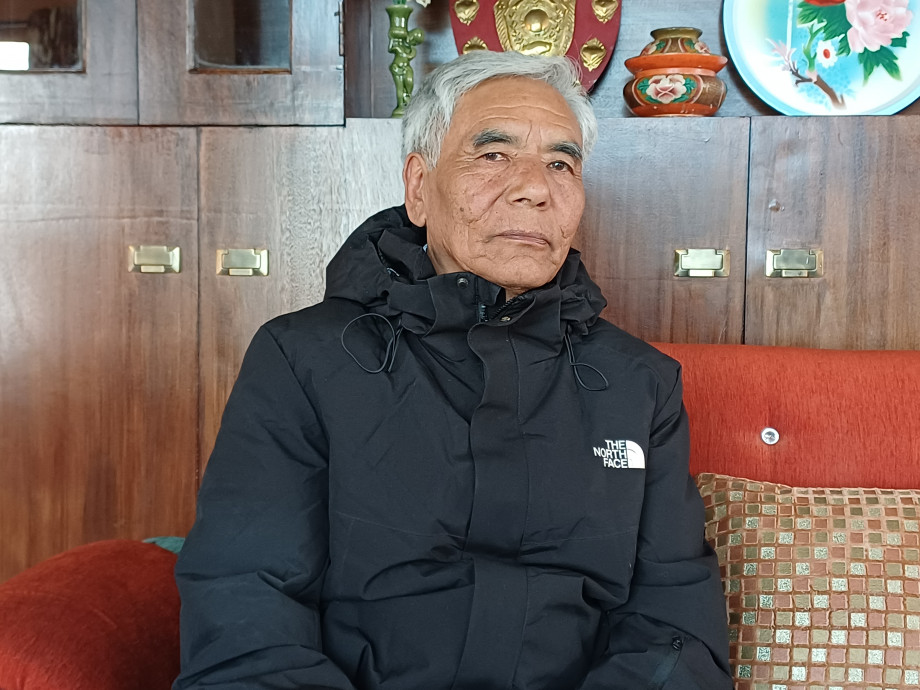
Q. Many congratulations on receiving the State Award 2026 in the Literature, Art & Craft category. Please share a little about your journey and how your interest in Thanka painting began.
Julley. I am from Phobrang village in Lalok Changthang. First of all, I would like to express my deepest gratitude to the UT Administration and the former Councillors of Changthang Lalok, Konchok Stanzin and Tashi Namgyal Yakzee, as well as all the people who recognised and appreciated my work. I am also thankful to everyone who has sent their best wishes. Such recognition encourages individuals to work harder and, more importantly, to value and preserve our traditions, culture and art.
I developed an interest in art at a young age, and it opened a new door in my life. At the age of 20, I completed two years of training in traditional Thanka painting at the Department of Handicrafts Training Centre, Leh. I learned under the guidance of Padma Shri awardee Late Tsering Wangdus Olthangpa of Nimoo.
After completing my training, I worked as a painting instructor at the Ladakh Ecological Development Group for 11 years, from July 1987 to September 1998. During this time, I also attended various workshops and handicraft exposure tours to Delhi, Rajasthan, Kullu, Dharamshala, Bangalore and Dehradun, sponsored by Dastkari Haat Samiti.
I also learned the art from Khanchen Tsewang Rigzin, under whose guidance a mural painting project was being carried out at Hemis Monastery. This gave me the opportunity to work and gain valuable experience. I was also fortunate to learn from Khenpo Togdol, who taught me the importance of design and how to use it effectively in painting. In addition, I learned mandala design and related work from Taklung Tsetrul Rinpoche.
Q. Can you tell us about your work and the projects you have undertaken?
I have carried out numerous works in both ancient and newly built monasteries across Ladakh. One of my major works was mural painting at Shang Monastery under the guidance of the renowned painter Ven. Khenpo Togdol. During this project, we painted images of the Buddha, Bodhisattvas, Dechog Lhagang, Wangon Chosum, as well as floral paintings and decorative pillar designs.
I have also worked on mural art in several important monasteries, including the ancient Nyingma monastery of Takthok in Sakti village, Guru Lhakhang, Chemday Monastery, the assembly hall of Likir Monastery, Muth Monastery in Nyoma, Igoo Gompa, and the Hemis Monastery Museum.
In addition, I undertook the repair and restoration of ancient paintings in the main assembly hall of Hemis Monastery. I have also carried out painting, restoration, and drawing of deities, as well as images of the Buddha and Bodhisattvas, in monasteries located in Kungyam, Korzok, Tsaga, Hemya, Liktsey, Matho, Nyi, Tukla, Chemday, Mangyu and Sumdha Chenmo.
I also worked on the wooden base known as “Shintsi” at Naro Photang in Shey. This project included colouring the seat of His Holiness Gyalwang Drukpa and carrying out mural artwork in the assembly hall.
Q. How do you see the changes in Thanka art over time?
Change cannot be stopped; it is a natural process. However, while embracing new developments, we must continue striving to promote and preserve our age-old traditions, culture and artistic practices.
In earlier times, natural and handmade colours were widely used in Thanka painting. Today, ready-made colours made with various chemicals are easily available in the market and are commonly used by artists. As a result, the traditional art of preparing natural colours has gradually disappeared.
The difference between natural and chemical colours is very evident when we use them. Natural colours have a warm and subtle quality and do not fade easily over time, whereas chemical colours appear brighter but tend to fade more quickly. Using natural colours is certainly better, but preparing them requires a great deal of time, effort and skill. For this reason, many artists today prefer to use ready-made artificial colours.
Over the years, Thanka art has also progressed in terms of recognition and livelihood opportunities. Earlier, only a few people practised this art because it did not offer much earning potential. There was often no fixed price for a Thanka painting; people would simply offer whatever they could afford or felt appropriate. Today, however, the situation has changed and artists have better opportunities to earn from their work.
Q. How many students have you trained so far, and do you still teach those who are interested in Thanka painting?
I worked as a painting instructor at the Ladakh Ecological Development Group, Leh, where I trained 38 students in this field. Training at an institutional centre and teaching at a private level are quite different. At a training centre, it is possible to teach many students at once, but now that I work as a freelance artist, it is difficult to accommodate a large number of students because my workspace is limited.
Despite these challenges, I still try to teach those who are genuinely interested in learning Thanka painting and provide them with incentives as well. Earlier, I had approached the Administration with a request for land to establish a training centre so that I could accommodate more students and pass on this knowledge to the younger generation. I hope that my request will be considered in the future.
Q. You have been associated with this art for a long time and have worked in many ancient as well as newly built monasteries. How important is it to preserve ancient art and traditions, especially when many people prefer to dismantle old structures and create new ones? What is your view on this?
I have travelled to many places and carried out different kinds of work. In many monasteries and shrines, I found that old paintings and artworks had been damaged and were replaced with new ones. In several cases, I suggested restoring the old paintings instead of replacing them. It is very important to preserve old paintings and traditional art in their original form because they help us understand the history and development of art forms in Ladakh.
Q. What is your advice to young and aspiring artists, especially those who want to learn this art?
If you are interested in Thangka painting, you should definitely pursue it. Today, there are not as many challenges as there were in earlier days. It has become easier to find teachers and proper guidance. The potential of this art in terms of income generation is also growing. At the same time, it is a noble profession that helps preserve an important cultural and spiritual tradition.
Message to the readers
Art is an important part of our culture and identity. Traditional arts like Thangka painting carry the wisdom of our ancestors. It is our responsibility to preserve and pass this heritage to future generations. I encourage young people to learn and value these traditions to keep our culture alive.
-
 Reach Ladakh Skara Yokma, Airport Road, Near Councillor Quarter, India.


© 2018 Reachladakh. All rights reserved.
Web designs By : India Internet