


One year on, Ladakh awaits justice for September 24 victims Martyrs’ Day observed; families seek accountability, adequate compensation and release of judicial inquiry report
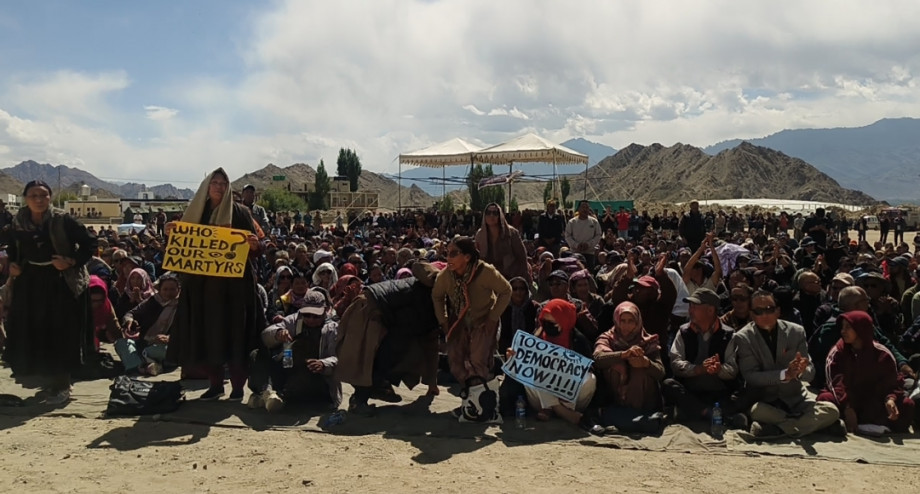
A year after the September 24, 2025 violence that claimed the lives of four young people, questions over the deaths, accountability and the circumstances that led to the firing remain unanswered, with the report of the judicial inquiry commission yet to be made public.
Martyrs’ Day was observed across Ladakh on September 24 to remember those who lost their lives during the agitation and to stand in solidarity with families who lost their children and loved ones. The day was marked by calls for justice, accountability and transparency over the events of last year.
The Ladakh Buddhist Association (LBA) has declared September 24 as Martyrs’ Day to commemorate 10 martyrs who sacrificed their lives for the cause of Ladakh between 1981 and 2025.
The earlier martyrs include Ven Lobzang Tsondus of Likir Monastery and Tashi Angchuk of Saspol, who lost their lives on January 24, 1981, during an agitation demanding Scheduled Tribe status for Ladakh.
On August 27, 1989, Nawang Rinchen of Samkar, Tsering Stobdan of Durbuk and Tsewang Dorjay of Saboo were killed in a firing incident at Leh’s Polo Ground during an agitation for Union Territory status.
The September 24, 2025 violence claimed the lives of late Havildar Tsewang Tharchin of Skurbuchan, Rinchen Dadul of Hanu, Stanzin Namgyal of Igoo and Jigmat Dorjay of Kharnak. Stanzin Dorjay of Skidmang later became the fifth person associated with the incident to be remembered as a martyr by the LBA.
Paying tribute to the martyrs, LBA President Chering Dorjey Lakruk said remembering their sacrifices were essential for the people of Ladakh and future generations.
“Justice has still not been delivered,” Lakruk said while referring to the September 24, 2025 violence. He questioned why the judicial inquiry report had not been made public and said people had the right to know who ordered the firing and what led to the deaths and injuries.
The issue of compensation also featured prominently during the Martyrs’ Day observance. On September 13, Lieutenant Governor of Ladakh Vinai Kumar Saxena sanctioned ₹15 lakh each to the next of kin of the four persons who died in the September 24 incident. The administration also approved ₹3 lakh for those who sustained major injuries and ₹1 lakh for those with minor injuries.
Former MP Ladakh Thupstan Chhewang termed the compensation inadequate for families who had lost their children and loved ones. He demanded compensation at least on par with the assistance announced in Delhi and called for a government job for one member of each affected family.
Apex Body Chairman Chering Dorjey Lakruk also questioned the compensation, saying the lives of Ladakhis were equally valuable. He appealed to people to remain united in seeking justice for those killed and injured.
Social activist Sonam Wangchuk, addressing the gathering, paid tribute to those who lost their lives and demanded justice for the victims.
Wangchuk alleged that unarmed protesters were subjected to excessive force and questioned the circumstances surrounding the firing. He said these issues should be established through the judicial inquiry.
He demanded the release of the inquiry report, saying it should clarify why the firing took place, whether a firing order was issued, how weapons were used and how the violence began.
Wangchuk said that if the report continued to remain unpublished, civil society could seek the formation of a “People’s Tribunal” involving retired judges and other institutions to examine the events.
He also directly held Union Home Minister Amit Shah politically responsible for the events and demanded his resignation, arguing that accountability should extend beyond individual police personnel to the political and administrative levels.
The Martyrs’ Day observance thus brought renewed focus on the September 24 violence, with families and civil society continuing to seek answers, accountability and the release of the judicial inquiry report a year after the incident.
-
 Reach Ladakh Skara Yokma, Airport Road, Near Councillor Quarter, India.


© 2018 Reachladakh. All rights reserved.
Web designs By : India Internet