


IT department organises Digital India awareness workshop in Leh
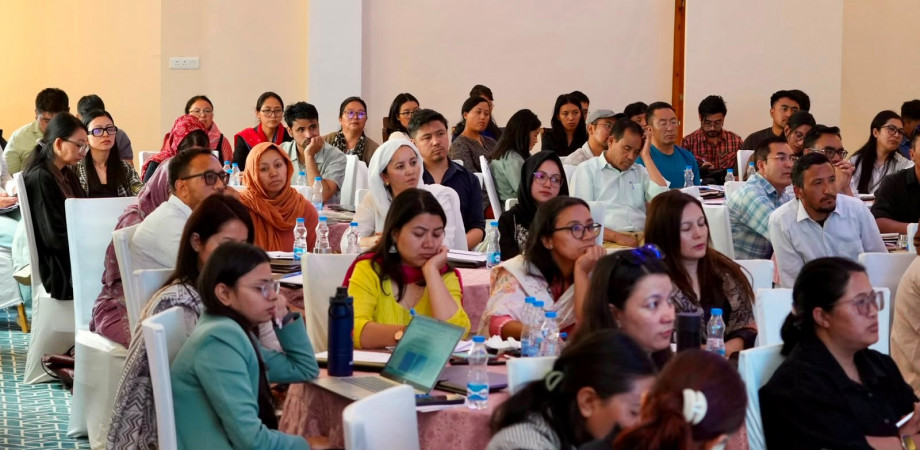
Reinforcing its commitment to advancing digital governance and strengthening the implementation of the Digital India mission, the Information Technology Department, UT Ladakh, in collaboration with the National e-Governance Division (NeGD), organised a two-day Digital India State Awareness Workshop at Hotel Diskitsal, Leh, on July 7.
The workshop aims to enhance awareness and build the capacity of government officials and stakeholders on key Digital India initiatives, Digital Public Infrastructure (DPI), and citizen-centric digital platforms to promote efficient, transparent, and technology-driven governance across Ladakh.
The programme began with a welcome address by the Information Technology Department, highlighting the importance of accelerating digital transformation and expanding citizen-centric digital services across the Union Territory.
Ajay Kumar, Additional Director, National e-Governance Division (NeGD), delivered a comprehensive presentation on India's Digital Public Infrastructure and the Digital India ecosystem. He emphasised the role of Application Programming Interfaces (APIs), the Digital Personal Data Protection (DPDP) framework, and Digital Public Infrastructure in enabling secure, efficient, and paperless public service delivery.
He also presented an overview of DigiLocker, describing its evolution into India's trusted digital document wallet. Kumar explained its key features, legal validity, regulatory framework, and integration with platforms such as UMANG, the Ayushman Bharat Digital Mission (ABDM), and SEBI. He highlighted how DigiLocker has reduced dependence on paper-based governance while improving citizen access to authentic digital documents.
Referring to India's digital transformation since 2015, he outlined the role of the India Stack architecture and the Jan Dhan-Aadhaar-Mobile (JAM) framework in building a robust digital governance ecosystem.
Sharing national adoption statistics and major use cases, Kumar also introduced Entity Locker, highlighting its potential benefits for organisations, MSMEs, trusts, societies, and government institutions.
Speaking on Ladakh's digital landscape, he noted that several government departments and institutions in the Union Territory are already integrated with DigiLocker and emphasised the potential to expand digital document services across all 33 government departments. He also highlighted opportunities for adopting Entity Locker in sectors such as tourism and hospitality.
Ramakant from NeGD conducted a session on UX4G (User Experience for Government), an initiative focused on improving the usability, accessibility, and inclusiveness of government digital platforms. He discussed the principles of user experience (UX), user interface (UI), and design thinking, encouraging participants to contribute to enhancing digital public services through user-centric innovation.
He also led a technical session on the National Single Sign-On (NSSO) platform – Meri Pehchaan, explaining how it enables users to securely access multiple government services through a single digital identity. The session covered authentication processes, DigiLocker integration, profile management, secure document access, API integration, and the platform's role in delivering seamless digital services.
The final technical session was conducted by Sarvesh Kumar, who presented the UMANG platform and the MyScheme portal. He highlighted how these flagship Digital India initiatives provide citizens with easy access to government services, welfare schemes, and public benefits through a unified digital interface, promoting transparency, accessibility, and inclusive governance.
The workshop witnessed active participation from officials representing various government departments, banks, universities, and other public institutions.
The sessions provided participants with valuable insights into Digital India initiatives, digital governance frameworks, and emerging technologies aimed at strengthening efficient, transparent and citizen-centric service delivery across Ladakh.
-
 Reach Ladakh Skara Yokma, Airport Road, Near Councillor Quarter, India.


© 2018 Reachladakh. All rights reserved.
Web designs By : India Internet