


Experts and public representatives deliberate on Zanskar's future at three-day summit
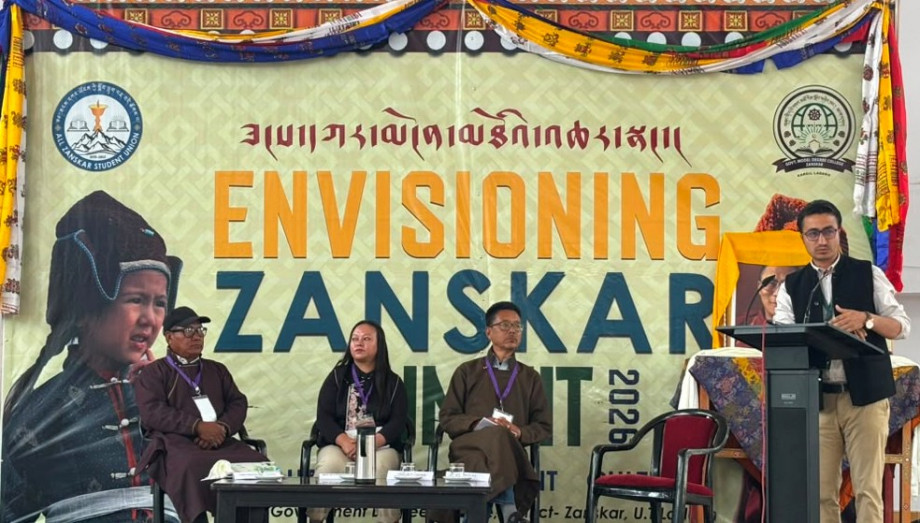
The three-day Envisioning Zanskar Summit 2026 commenced at Government Degree College (GDC) Zanskar on July 7. Organised by GDC Zanskar in collaboration with the All Zanskar Students' Union, the summit has brought together academicians, policymakers, public representatives, religious scholars, students, and members of civil society to deliberate on the future of Zanskar through panel discussions and collective dialogue.
The inaugural session began with the ceremonial lighting of the traditional lamp by Khen Rinpoche Lobzang Khedrup, symbolising wisdom, enlightenment, and the pursuit of knowledge. The ceremony was followed by a folk song presented by Stanzin, reflecting the rich cultural heritage of Zanskar.
In his inaugural address, Khen Rinpoche Lobzang Khedrup emphasised the importance of preserving Zanskar's spiritual, cultural, and ethical values while embracing sustainable development. He urged the younger generation to remain connected to their roots and actively contribute to the holistic development of the region.
Welcoming the guests, panellists, students, and participants, Principal of GDC Zanskar, Dr. Amjad Ali Abassi, described the summit as an important platform that brings together diverse stakeholders to collectively envision the future of Zanskar. He congratulated the All Zanskar Students' Union for organising the summit in collaboration with the college and appreciated its efforts in fostering meaningful public discourse.
The Principal noted that Zanskar is undergoing rapid socio-economic transformation, making it essential to balance development with the preservation of its unique cultural identity, ecological wealth, and traditional knowledge systems. He encouraged participants to actively engage in the deliberations, stating that informed dialogue and collective participation are key to building a resilient and prosperous future for the region.
The first panel discussion, "Envisioning Zanskar: A Vision for Tomorrow," was moderated by Tenzin Loden. The panel featured Dr. Jamphel Sheyan, Assistant Professor of English at GDC Zanskar; Executive Councillor, LAHDC Kargil, Phuntsok Tashi; Councillors Stanzin Lakpa and Stanzin Jigmet; and Padma Shri awardee Tsultim Chonjor.
The panel discussed sustainable development, quality education, infrastructure, tourism, employment generation, and inclusive governance. Dr. Jamphel Sheyan highlighted education as the foundation of social transformation and sustainable development, stressing that meaningful progress must be rooted in knowledge while safeguarding Zanskar's culture, biodiversity, and traditional values. Other panellists emphasised community participation, youth leadership, responsible tourism, and long-term planning for balanced regional development. The session concluded with an interactive question-and-answer session.
The second panel discussion, "Preserving Identity in a Changing World," was moderated by Haider Askary, Assistant Professor of Sociology at GDC Zanskar. Panellists Dr. Sonum Wangchuk, Kunzes Dolma, and Rigzin Samphel discussed the importance of preserving indigenous traditions, local customs, architecture, languages, and community values while embracing positive social and technological change. They highlighted the role of educational institutions, families, community organisations, and youth in ensuring that development remains culturally sensitive and inclusive.
Following the lunch break, the third panel discussion on "Language and History" was moderated by Dr. Villayat Ali, Assistant Professor of History at GDC Zanskar. The session featured Dr. Tsewang Gyalsen, Ven. Tsering Chosphel, Ven. Thupsten Palden, and Dr. Stanzin Minguer. The speakers emphasised the need to preserve indigenous languages as carriers of history, identity, and cultural heritage. They advocated promoting mother-tongue education, documenting oral traditions, and encouraging younger generations to learn and use local languages.
An awareness session on cybercrime and digital safety was also conducted by Yangzom and Tashi Dawa, who educated participants about online fraud, cybersecurity, digital ethics, safe social media practices, and mechanisms for reporting cyber offences.
The first day of the summit concluded with enthusiastic participation from students, faculty members, public representatives, and civil society members.
The remaining sessions of the summit will continue over the next two days with further panel discussions on issues of regional importance aimed at shaping a sustainable and inclusive future for Zanskar.
-
 Reach Ladakh Skara Yokma, Airport Road, Near Councillor Quarter, India.


© 2018 Reachladakh. All rights reserved.
Web designs By : India Internet